
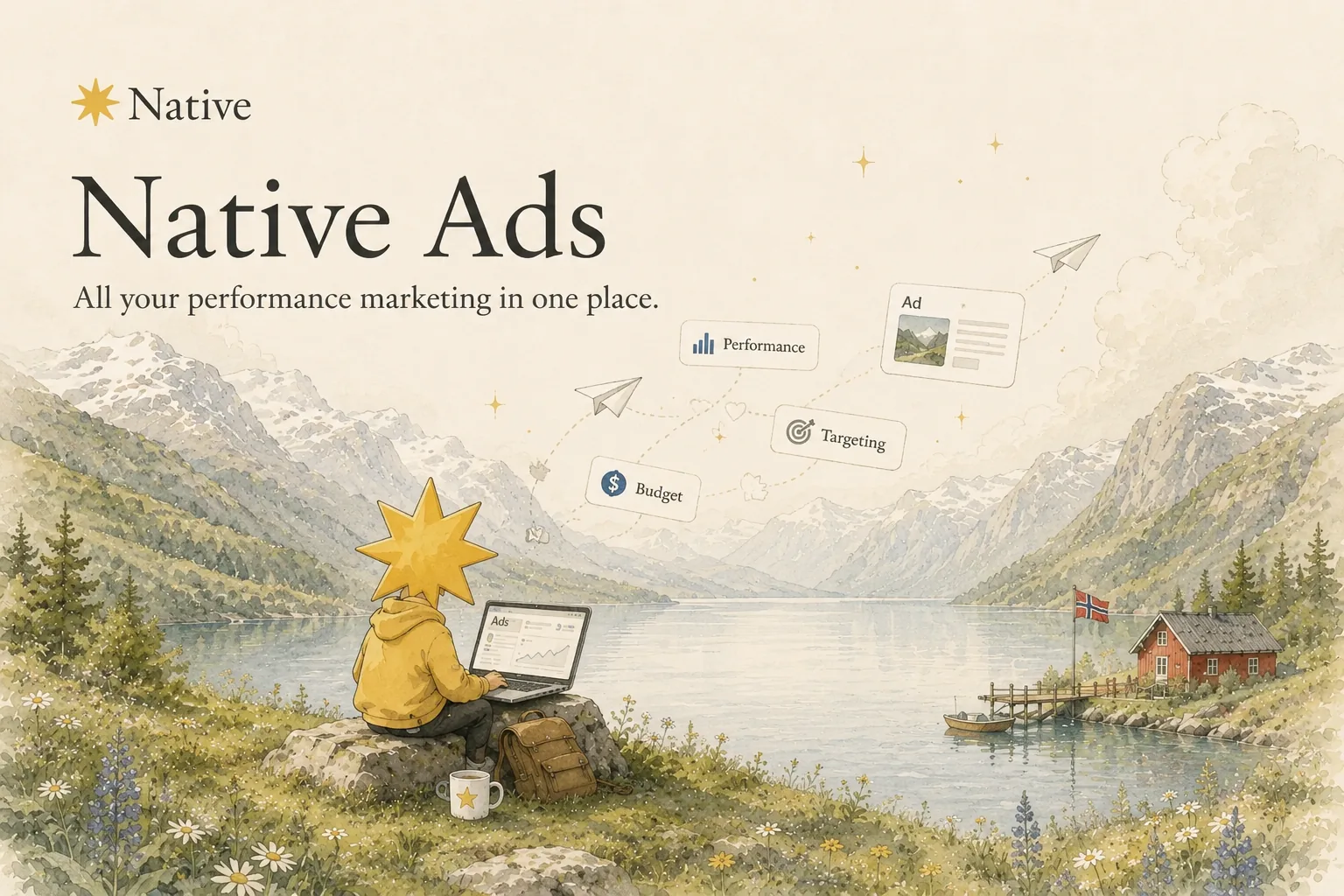
Native Ads is live.
You set the budget. Native does the rest.
It writes the value props. It launches the ads on Facebook and Instagram. It kills the ones that don't work, and doubles down on the ones that do.
Small businesses shouldn't need a $5,000 a month agency to run performance marketing. From today, they don't.
The half of marketing we hadn't built yet
Organic content is patient work. You show up week after week, and the people who already know you slowly come to trust you a little more. It compounds. It also has a ceiling, and that ceiling is roughly the number of people who already follow you.
Paid is how you get past it. It is the difference between being findable and being found.
Most business owners know this. Very few of them run ads, and not because they don't want more customers. It is because both of the available routes are bad ones.
The first route is Ads Manager. It is a professional tool, built for people who buy media forty hours a week, and it shows. Campaigns, ad sets, ads, objectives, bid strategies, attribution windows. You can learn it. It will cost you several evenings and a few hundred dollars in tuition while you do.
The second route is an agency. The good ones are genuinely good. They also start around $5,000 a month, on top of what you spend on the ads themselves. For a café, a clinic, or a carpenter, that math has never worked.
So most small businesses do nothing, and the businesses with marketing departments keep buying up the attention.
What you actually do
Open Ads in Native and answer a few questions. It takes about five minutes, once.
- Have you advertised before? If you have, Native can pull in your five most efficient past ads, the ones with the lowest cost per click, and write up what it thinks made them work. Those become a reference for everything it builds next. If you haven't, it skips the question.
- Who are you trying to reach? Native drafts this for you from what it already knows about your business. Edit it, or regenerate it, or leave it alone.
- What should people do when they see the ad? Buy something, sign up, make a booking, visit the site, get to know you, or follow you. Pick one.
- Anything specific to feature? Products from your catalogue, your value props, your reviews, customer stories, milestones, your team. Toggle what belongs in this round. Set where the ads should send people.
- How many ads? Anywhere from five to fifty.
Then Native builds them.
What comes back
Not one ad. A batch of them, and each one is a complete piece of work.
Every ad gets its own image, its own headline, and its own body text. On top of that it gets five alternative headlines and five alternative body texts, so a single creative arrives with ten ways to say what it says.
The images are built for the feed rather than borrowed from a stock library. They use your real brand colours, your fonts, your logo, your website, and the actual photos in your media library, and Native rotates through those photos across batches so your ads don't all look like the same afternoon.
You can edit any of them, roll one back to an earlier version, drop the ones you don't like, and download the whole set as images or a PDF if you want to use them somewhere else. They are yours either way.
It writes the argument several ways, on purpose
This is the part that does the real work, and it is worth understanding.
Say you sell outdoor saunas. There are at least three honest reasons to buy one, and they are not the same reason. Recovery after training. Something that holds its value on the property. Sunday mornings when the whole family is in the same room for once.
Write one ad and you are betting the budget on a guess about which reason matters most. Nobody is good at that guess. We aren't either, on day one.
So Native doesn't guess. It writes all three, builds the creative for each, and sends the whole batch into a single campaign on one shared daily budget. From there Meta's delivery system does what it is genuinely excellent at: it puts spend behind whatever is earning it and quietly starves whatever isn't. More variants means more chances for it to find the one that lands.
Your budget doesn't change. What your budget buys does.
It learns from your edits
When you change something in an ad, Native works out whether that was a one-off or a rule.
Rewrite a headline because it was too formal, and the next batch will already be less formal. Cut a claim you are not comfortable making, and it stays cut. These become a visible list of learned preferences that you can read, keep, or delete, so the thing is never quietly deciding things about your brand behind your back.
The ads you edit least are the ones you'll get more of.
It learns from what wins
Once ads are running, Native ranks them. Either by efficiency, meaning the lowest cost per click once an ad has spent enough to have actually proven something, or by total clicks.
That ranking includes ads Native didn't make. Anything else in the same Meta ad account shows up alongside them, so you get one honest league table instead of a flattering one.
When something is clearly working, you can point at it and ask for more like it. Native reads what made it work and seeds a new batch from it. Winners can also go into your reference library, where they steer everything generated afterwards.
The numbers, in a language you already speak
For each ad you get what you spent, how many people it reached, how many clicked, what each click cost, what each view cost, and how long it has been live.
Around those numbers you get the context that makes them mean something: how this week compares to last, how this ad compares to the rest of your ads, and where it ranks. So instead of a cost per click floating in space, you get "23 percent cheaper than your average" and a position in your own top ten.
Native Analytics sits in the same place, so you can also just ask. Which ad brought in the most clicks last week? Is this batch cheaper than the last one? Where should next month's budget go? You get a sentence back instead of a spreadsheet.
The budget stays yours
One daily budget covers everything Native is running for your brand. Set it, change it, or turn it off, whenever you like. There are three suggested starting points in the product if you would rather not pick a number cold.
Two things worth being clear about, because this is where advertising tools usually get slippery.
Your ad spend is billed by Meta, directly, on your own ad account. Native does not take a cut of it, does not mark it up, and never touches the money. Generating a batch draws on the same workspace usage as everything else Native makes for you, so there is no ads add-on to buy and no separate plan to upgrade to. And if a batch ever comes back short of what you asked for, the difference is credited back automatically.
Or let it run without you
Turn on autopilot and Native wakes up every morning, builds a fresh batch from everything it has learned so far, and can push it live on its own.
You can still make batches by hand whenever you want. You can pause an ad, reactivate it, pull it down, or delete it at any point. Autopilot is a setting, not a commitment.
It runs on the official road
One thing worth saying plainly, because it matters more than it sounds.
Advertisers get their accounts flagged for connecting unvetted tools to them. It happens often enough to be a real risk, and having an ad account restricted is a genuinely bad week.
Native runs on Meta's official Marketing API through an approved partner integration. One connection covers Facebook and Instagram, the ad account stays yours, and you can open Ads Manager and inspect every campaign yourself whenever you feel like it.
Where ads sit in the stack
Scheduling was never the point.
Publishing on time is one step in a job that has about seven, and it is the easiest of them. The hard parts are deciding what to say, making it, knowing whether it worked, answering the people it brings in, and putting money behind the things that earn it.
Native now does all of it.
- Ideas drawn from your actual business, not a generic content calendar.
- Creation, words and images, in your voice.
- Planning and publishing across your channels.
- Inbox, so the messages, comments, and reviews that come back land in one place.
- Analytics that answer questions instead of drawing charts.
- Ads, now, so the things that work reach past the people who already know you.
That is a marketing department. It costs less than a day of one.
Meta today. The rest is coming.
Native Ads launches on Facebook and Instagram, which is where the customers of most local businesses actually are.
More platforms follow, on the same principle. One budget, one place, and no ad manager to learn. When they arrive, they arrive inside the screen you are already using.
How to get started
Native Ads is in your account now. Log in, open Ads from the menu, connect Facebook and Instagram, and set a daily budget you would be comfortable spending for a week.
Then let it work.
We're just getting started.