
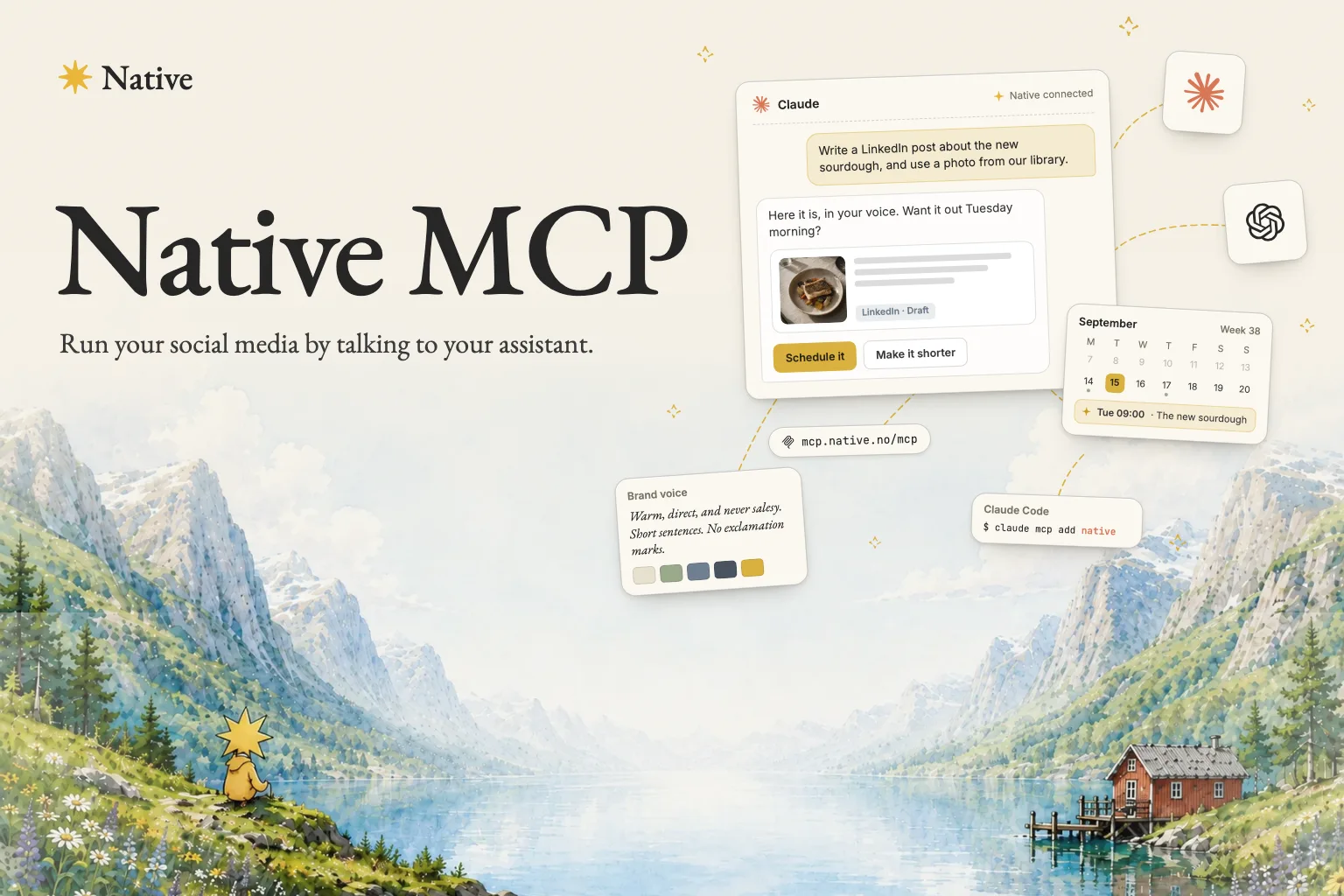
Native MCP is live.
You already talk to an AI assistant. It drafts your emails, answers your questions, and explains things at eleven at night. But when you asked it for a post, it handed you a paragraph and left the rest to you. Open Native, paste it in, find a photo, pick a time.
Not anymore. Add one address to Claude or ChatGPT, sign in with your Native account, and the assistant you already use can do the work inside Native. It knows your brand, writes the post, makes the image, and puts it on your calendar.
Say hello to Native MCP.
MCP, in plain words
MCP stands for Model Context Protocol. It is an open standard that lets an AI assistant use real tools instead of only talking. Think of it as a socket. Native exposes one, your assistant plugs in, and from then on it can do things in your account rather than tell you how to do them yourself.
It is the same standard Anthropic and OpenAI have built into their assistants, so there is nothing to install and nothing to learn. You paste an address, you sign in, and you talk.
It knows your brand before it writes
This is the part a general assistant cannot do on its own.
Everything Native has learned about your business is available to it. Your tone of voice and the way you write. Your products, with real names and real prices. Your own photos, already sorted by what is in them. Your calendar, and what already went out.
So when you ask for a post about the new sourdough, it does not guess what your bakery sounds like. It writes the way you write, uses a photo you actually took, and knows what is already planned for that week.
You see the work, not a description of it
Ask what is on the calendar and Native sends back the calendar itself, rendered right there in the chat. Ask for a post and you get a real preview, the way it will look on the platform, with the image and the caption in place.
You look at the actual thing before you agree to it. In Claude these arrive as interactive cards you can look through. In ChatGPT you get the same content as text and images, with a link straight into Native.
Things you could just say
There is no syntax. You talk, and the work happens in Native.
What is on our calendar for next week?
Write a LinkedIn post about the new sourdough, and use a photo from our library.
Give me ten posts for the autumn menu, each from a different angle.
Make that caption shorter and lose the emoji.
Generate three images for this one in our usual style.
Good. Schedule it for Tuesday morning.
How did last month do on Instagram compared to Facebook?
What it can do
Real actions in your account, not suggestions for you to carry out afterwards.
Write a post. From a sentence, a product or a picture, built for each platform you publish to. Or ask for a batch: one brief, up to twenty drafts, each taking a different angle.
Rework the words. Shorter, warmer, less salesy. Ask, and it writes the caption again in your voice.
Make images. New images in your brand style, saved to your library and attached to the post. Or point it at a photo you already have.
Use your own videos. Upload a clip to your library and put it on a post, the same as an image.
Look up your products. Names, descriptions, prices and product photos, so a post uses the real one at the real price. Add a new product from the chat too.
Put it on the calendar. Schedule a post, move it, or pull it back to drafts. Publish it now if it cannot wait.
Get a second opinion. Share a post for review and read the feedback that comes back, without leaving the conversation.
Check what happened. What is planned, what went out, the link to the live post, and the numbers behind it, per platform and per post.
Connect a channel. Missing Instagram? Ask, get a link, connect it, and carry on.
It asks before it changes anything
An assistant with real tools needs real manners.
You sign in with the Native account you already have, so the assistant reaches exactly what you reach and nothing else. Your access is checked on every request, not once when you connect.
Before it overwrites your words, your images or your times, or touches anything that is live, it asks you first. And it only tells you a post is scheduled once Native has confirmed it is. No quiet mistakes, and no confident answers about things that did not happen.
Remove the connector in your assistant and its access stops the same moment. Your Native account stays exactly as it was.
One address, no API keys
There is no key to generate, store or leak, and nothing to install. The address is the same everywhere:
https://mcp.native.no/mcp
Claude, desktop and web: Settings, then Connectors, then Add custom connector. Name it Native and paste the address. Claude setup guide.
ChatGPT: Add a new MCP server and paste the same address. ChatGPT setup guide.
Claude Code: one line in your terminal.
claude mcp add --transport http native https://mcp.native.no/mcp
Codex takes the same address. Because the standard is open, assistants that adopt it later will connect the same way.
Where MCP sits
Native was built to run the whole job. The ideas come from your actual business. The words and the images are made in your voice. The week gets planned and published across your channels. The replies land in your inbox. The numbers explain themselves. The budget goes behind whatever works.
MCP does not add a step to that. It removes one. The place where you already think out loud is now a place you can run your marketing from, and Native is still the thing doing the work underneath.
How to get started
Native MCP is open to every Native account today. Add the address to your assistant, sign in, and ask what is on your calendar.
You did not start your business to learn another tool. Now the one you already talk to can do the work.
We're just getting started.